What Is Interstellar Comet 3I/ATLAS? A Simple Explanation
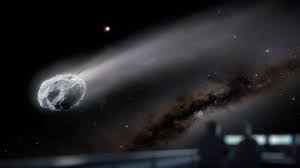
Interstellar comet 3I/ATLAS has captured global attention as only the third confirmed object from outside our solar system ever detected. Scientists are tracking it closely not because it threatens Earth—but because it offers a rare opportunity to study material formed around another star.
In this article, you’ll learn what interstellar comet 3I/ATLAS is, where it came from, why it appears green, what its strange “anti-tail” means, and whether it poses any danger to our planet.
What Makes a Comet “Interstellar”?
Most comets originate from within our solar system, typically from the Kuiper Belt or the distant Oort Cloud. An interstellar comet, however, comes from outside the Sun’s gravitational influence.
What makes a comet interstellar:
- Travels on a hyperbolic (unbound) orbit
- Has too much speed to be captured by the Sun
- Will never return after passing through
3I/ATLAS meets all these criteria, confirming it formed around another star system before drifting through interstellar space for millions—possibly billions—of years.
Where Did 3I/ATLAS Come From?
One of the most common questions is: Where did 3I/ATLAS come from?
While scientists cannot trace it to a specific star, its trajectory suggests it originated in the Milky Way galaxy, ejected from a distant planetary system during early planet formation.
This makes 3I/ATLAS a cosmic messenger, carrying pristine material older than Earth itself.
How Was Interstellar Comet 3I/ATLAS Discovered?
3I/ATLAS was discovered in July 2025 by the Asteroid Terrestrial-impact Last Alert System (ATLAS). Initially flagged as an unusual object, follow-up observations quickly confirmed its interstellar origin.
How scientists track interstellar comets:
- Automated sky surveys
- Rapid orbit calculations
- Spectroscopy to analyze gases
- Space telescopes (Hubble, ESA missions)
Early detection allowed scientists to study its evolution as it approached the Sun.
How Big Is Interstellar Comet 3I/ATLAS?
Another key question is how big is interstellar comet 3I/ATLAS.
Estimates vary because comets are surrounded by glowing gas and dust called a coma. Current data suggests:
- Nucleus diameter: ~0.5 to 1 km
- Coma size: hundreds of thousands of kilometers
Despite dramatic images, the solid core is relatively small—comparable to a medium-sized mountain.
Why Is Comet 3I/ATLAS Green?
Many observers noticed that images of 3I/ATLAS appear bright green, prompting curiosity and speculation.
Why is comet 3I/ATLAS green?
The green color comes from:
- Diatomic carbon (C₂)
- Cyanogen (CN) gas
When sunlight excites these gases, they glow green. This is normal comet chemistry, not an artificial or dangerous phenomenon.
What Is an Anti-Tail Comet?
One of the strangest features of 3I/ATLAS is its apparent anti-tail, which seems to point toward the Sun.
What is an anti-tail comet?
An anti-tail is:
- A dust feature, not a real backward tail
- Caused by viewing angle effects
- Seen when Earth crosses the comet’s orbital plane
This optical illusion has been observed in many comets throughout history and is well understood by astronomers.
3I/ATLAS Closest Approach to Earth
A critical concern for many is 3I/ATLAS closest approach to Earth.
Here’s the reassuring reality:
- Closest distance: ~1.8 astronomical units
- That’s over 260 million kilometers away
- Farther than the Sun is from Earth
At no point does the comet come anywhere near Earth.
Is 3I/ATLAS Dangerous to Earth?
Let’s answer this directly.
Is 3I/ATLAS dangerous to Earth?
No. Absolutely not.
Reasons:
- Very distant flyby
- Small nucleus
- Stable, predictable orbit
- Constant international monitoring
Organizations like NASA, ESA, and the UN’s International Asteroid Warning Network confirm zero impact risk.
3I/ATLAS vs ʻOumuamua: What’s the Difference?
Comparisons between 3I/ATLAS vs ʻOumuamua are common, but the objects are very different.
| Feature | ʻOumuamua | 3I/ATLAS |
|---|---|---|
| Type | Asteroid-like | True comet |
| Coma | None | Large, active |
| Tail | No | Yes (and anti-tail) |
| Chemistry | Unknown | Typical comet gases |
3I/ATLAS behaves like a classic comet, making it easier to study and understand.
Will 3I/ATLAS Return?
Another frequent question is will 3I/ATLAS return.
The answer is simple:
- Its orbit is hyperbolic
- It is not bound to the Sun
- It will exit the solar system forever
This is a once-in-a-lifetime visitor.
Why 3I/ATLAS Matters to Science
Interstellar comets offer insights we cannot obtain otherwise:
- Clues about planet formation in other systems
- Chemistry beyond our solar system
- Comparison with native comets
- Understanding how common life-building materials are
Each interstellar visitor improves our understanding of the galaxy.
Frequently Asked Questions
Can I see 3I/ATLAS with my eyes?
No. It requires telescopes or long-exposure astrophotography.
Is it artificial?
No credible evidence suggests artificial origin.
How many interstellar objects have we found?
So far: ʻOumuamua, 2I/Borisov, and 3I/ATLAS.
Final Thoughts
Interstellar comet 3I/ATLAS is not a threat, not a mystery weapon, and not a sign of alien technology. It is something far more valuable: a natural sample from another star system, briefly passing through our cosmic neighborhood.
For scientists—and curious minds—it’s a reminder that our solar system is part of a much larger, dynamic galaxy filled with wandering worlds.





Post Comment